view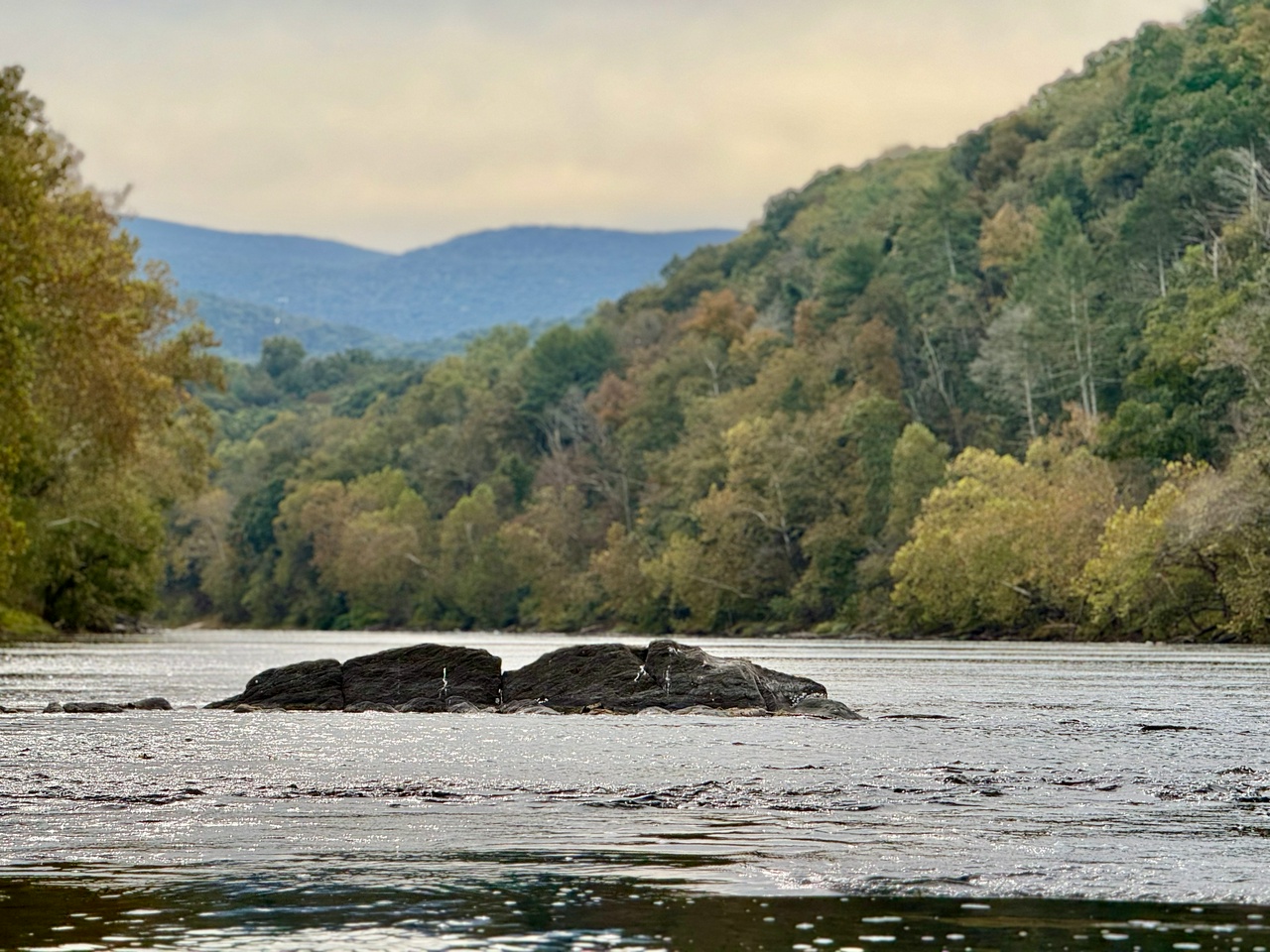
Follow the Great Blue Down the Shenandoah
I’m dropped in about fifteen miles upriver. The air is damp and cold, but I’m good for it; the fleece coat feels good. I pull the kayak into the river, my feet barely gripping the moss-covered rocks, and the water feels almost lukewarm around my ankles—a stark contrast to what my driver had told me. This is bass water, I think to myself; not the cold upstream trout water I was used to.
As I settle into the kayak, it bobs beneath me, and I scan my surroundings with that peculiar readiness of beginning a long journey, as though all seven hours of river might somehow reveal themselves in a single glimpse.
“Can you read the water?”
The freshly-degreed river guide had asked me that when I checked in this morning. Now, as the first rapids appear ahead, I begin wondering what exactly it means to read a river.
The beginning of any river journey seems to me the easiest part, lacking the primal sting nature deals later, after the physical toil has run its course. So far, the morning feels vital, much like my coiled spine, which has not yet carried the weight of my wanderlust, or my unmarked thumbs around the paddle’s grip, which have not yet learned the river’s cadence.
I tip the kayak toward what I believe is the first white water, unmistakable beneath the dark gray morning sky that turns the Shenandoah nearly blue-black. A shelf of bedrock, reminiscent of the coastal Fall Line, stretches across most of the river.
“You’ll need to go left at the first rapids,” my driver had told me.
He had given me the cheat codes for all the major rapids but I remembered only the first. I had only slept two hours in my tent the night before.
I drive my kayak over the first shelf of rocks without a flip. Off to a good start.
Afterward come riffles, enough to keep me awake, and then the river slackens until I paddle for what feels like an hour before the sound of moving water stirs me again. Somewhere early in the journey I notice a flock of mallards bobbing close to shore. Their green and blue catch what little light the morning gives them, though it is the white collar that reaches my eye first.
I paddle toward them at no cost to my journey, careful not to slap the paddle against the surface. The river isn’t helping me anyway. It is at a record low, and whatever assistance I imagined receiving from the current has mostly disappeared.
For a moment I become lost in the birds: beautiful little things in such a remote piece of Virginia, as though the mallards somehow know they can come here in peace.
Then camouflage moves behind them. Two hunters crouch quietly in the brush.
I bow my head slightly, understanding their place here too, and the old game that men and animals have played for hundreds, perhaps thousands, of years. Then I pull the water behind me and move away, leaving them their space.
Along the banks, hardwoods begin to arrange the river. At the edge, drinking their share of water and hanging their reflections beneath themselves, grow trees I associate with lower country: red maple, black walnut, ash, birch, those low-hanging sycamores. Behind them rise gum, hickory, oak and sassafras, the upland hardwoods where I imagine birds of prey sitting watch.
Next, the river takes me beneath a gorge of gently descending stratified rock. Congregations of orange and yellow have already appeared in the early autumn canopy, subdued for now beneath the dim morning light. Their thin trunks somehow cling to the rock, growing from places that do not seem generous enough to sustain them.
Then the water thins.
My hull begins touching bottom, and with each scrape against the fiberglass I question the wisdom of kayaking so far when the current has so little interest in carrying me. I begin wondering whether there will be any kayak left by the time I finish.
Grrrrk.
Then the hull releases. The craft glides again, and off to my right I notice my first great blue heron fishing from the final exposed edge of a cliff.
He appears unbothered by me but I know better.
He sees me and chooses to fish until the last possible moment, waiting until I have nearly flank him before lifting himself on those enormous wings and flying downstream toward the very place I am going.
I will follow this heron over and over again.
Before I can settle back into my paddle, the kayak begins turning beneath me.
The river seems to say, Look sharp.
Ahead comes the sound of white water and my lazy floating ends. So, temporarily, do the complaints of my body. I grip the paddle too hastily, lose my rhythm and stroke twice into the same patch of calm water. The kayak leans dangerously toward the surface.
Don’t do that.
I hear the warning clearly enough from the craft, though I will do it at least three more times before the journey ends.
A few more rapids follow, the Shenandoah testing her new waterlubber. With the sun rising, the surface begins to shimmer and reading the water becomes harder. I find myself approaching ledges slowly enough that I can peer over them before choosing a way through, something perhaps only possible because the river is nearly standing still.
But occasionally the water gathers itself. A drop appears and the river accelerates, and suddenly the time for contemplation disappears. By the time a hidden obstacle reveals itself, the kayak may already have passed the point where turning is useful.
I notice how much of kayaking is not really paddling but anticipation: recognizing what the surface suggests about what lies beneath it. A slight change in the speed of the water perhaps.
A submerged rock can turn the boat port or starboard before I understand what happened.
And this is under a muted sky. I imagine Mother Nature polishing the river into her own mirror beneath full sunlight. What would remain to read then but a million sparks trembling on every undulation?
Beyond another set of rapids I realize I have missed the heron again. He is already flying toward quieter water, apparently more annoyed by me than by the rocks.
By now the Shenandoah has turned sapphire beneath the late morning sky. I know I must have traveled nearly half the distance, yet the urge to check my phone’s GPS seems strangely inconsequential. My imagination stretches instead into the autumn stillness as the last rapids diminish behind me.
For a moment I notice that the river is almost the only thing moving, except for the occasional leaf fluttering down to join it, but the Shenandoah continues.
Rivers have always done this, moving onward regardless of what changes around them. Forests rise and disappear. Roads arrive. People cross them, dam them, name them, fish them, drown in them, then build on them and tear it all it down to do it over again. The river carries on with the same indifference.
Soon the heron appears again, and this time he is not alone. Two great blues fish the same narrow eddy while respecting that subtle distance wading birds seem to understand without instruction. I stop paddling and admire the long legs, long necks, the strange geometry of bodies capable of folding themselves into that infamous S.
The current gives me passage on their starboard side, so I take a photograph.
Farther downstream, a rustling reaches the hollow of my ear—the first sound all morning that seems too heavy to belong to a bird.
A whitetail.
The deer noses around in the dirt until an unnatural sound reaches him across the water. My kayak slowly rotates toward the bank, almost the way it did with the herons, and despite my attempt at remaining silent he stares directly at me, his head turned over his shoulder.
I take another photograph and feel grateful for the sight of a mammal in what has so far seemed a sky-dominated world.
There is something reassuring about seeing animals still locked to the earth. Birds can escape us vertically but mammals remain confined, like us, to terrain. The whitetail is hardly threatened in Virginia, but that does not make seeing one matter less.
As I become another small thing disappearing downstream and the riffles swallow the sound of my paddle, the deer’s great ears remain turned toward me. Then I wonder if another hunter waits behind him.
The river bends downward again, and I remember the question from the freshly-degreed river guide.
Can you read water?
What, exactly, does it mean when the surface descends without breaking, as though gravity has become slightly stronger in one particular place?
Then I remember my driver. “There will be a three-foot ledge,” he had told me. Either I could hit it directly and get wet or cheat around it. Unfortunately, I cannot remember which side was the cheat.
The kayak is already being drawn in when I decide that perhaps this is a learning opportunity. From above, the ledge looks steeper than it really is, enough of a drop to upend the craft I have worked so hard to keep dry. I try briefly to resist the current, practicing the reverse paddle I have been learning over the past few hours, but there comes a moment when resistance stops being useful.
So, I turn the bow downstream.
The kayak scrapes over a piece of rock that I imagine began forming this notorious ledge millions of years ago, and here I am offering my hull to it, depositing microplastics on something that predates almost everything I understand.
One butt-scoot and I am over. The hull is no longer the only thing wet. A small wave curls over the side, and the wool socks buried in the recesses of the kayak lose whatever protection I thought I had given them.
This seems like a good time for tea, I think to myself.
I brew some Scottish tea I picked up the night before, managing to steep a hot cup on the river. Unfortunately, my thermos makes a poor mug. The water refuses to cool. I wedge the tea between my wet legs to wait out the thermos’s fine properties as an insulator and continue paddling.
Then I get cocky. The river widens into deep open water. I find a good stride and imagine myself somewhere offshore, kayaking across the deep blue ocean toward whales. Lost in my imagination, and working the paddle swiftly like my ancestors, my kayak gains velocity on the water but not for long.
Thunk I'm caught completely in surprise as the bow finds a hidden rock beneath the surface.
The impact is perfect—straight on. The kayak turns neither sideways nor upward nor downward. The rock simply stops the craft and I'm perplexed by the impossible hit. My feet drive against the braces while the rest of me tries to continue downstream.
What I notice most is not the ache of the impact. It is hot tea spreading through my pants.
Half remains in the thermos, now finally cool enough to drink, as though whatever heat had collected at the top escaped with the tea that spilled over me.
Farther on, when I know I must be nearing the final part of the trip, a flash of white catches my peripheral vision.
Tail first.
A bald eagle.
Sometimes the surest way to know an eagle is that sudden white, especially beneath blue or pewter skies where the tail flashes like a snowy peak. The bird makes no sound. I hear neither chirp nor cry, and so I watch in the peculiar quiet that follows something magnificent appearing without announcement.
White tail. Deep brown body. Swiveling head.
He follows the longest corridor of river I have seen any bird take that day, moving toward autumn colors now brightening in the sunlight, shrinking gradually until he becomes a point and then disappears against the mountain.
I hope I see him again. Meanwhile, the river has another lesson.
I had assumed it would deepen as I traveled downstream, as rivers generally do the farther they are from their headwaters, but the Shenandoah disagrees.
Grrrrk
The hull drags across rock again.
It amazes me that a river can nearly cradle a person to sleep with the peaceful repetition of its crests and troughs while, only inches beneath the surface, entire ledges wait in ambush. The rocks lie there unseen until a yellow kayak arrives and scrapes the moss from their edges.
I wiggle my hips, bounce once, twice, hoping the kayak moves with me, and I skim across the rock like a skipping stone until suddenly the hull releases into cold deep water. Then I look down and marvel at the apparent fathoms beneath me.
Every so often I notice rainbows beneath the boat—not trout, but aquatic vegetation spreading over the bedrock. Algae, river weed, submerged grasses carrying bluish hues tarnished by years of mud. Beneath them appear mudstones, limestones and sedimentary layers that continue through the river bottom indiscriminately until a slab of this dolomite or plate of shale finds itself in a different bend of the river, unimposed by what land or water passes above.
This may be what makes the South Fork of the Shenandoah most spectacular to me. It is not merely what the river displays but what it conceals. The layers beneath the water introduce another landscape entirely, geological and biological, present all along but a mystery to our eyes most of the time.
The last couple miles soften.
Camps begin appearing along the shore, but the river itself feels peaceful. The banks become gradual and clay-rich, reminiscent of coastal plain creeks. Trees lean farther across the water as if claiming greater ownership of it, their roots gripping muddy shallows. Bedrock comes and goes, which both my hull and my arms appreciate.
For a while only neighborhood hounds can be heard calling to one another from somewhere above the hills.
I stop now and then to type fragments of this story into my iPhone.
Then the river widens.
Its quieter sounds begin revealing themselves. Crickets keep their rhythm in the woods, and the cicadas, diminished with summer’s departure, continue until the first freeze will take them. One of the dogs sounds like a terrier from the pitch of its bark. A beagle joins in too.
Not long before, I had watched a mail truck disappear up a private road. Perhaps it is simply the dogs’ afternoon ritual to harass the postman.
The current gives me another slow tour of the bank. The kayak nudges past branches and fallen logs. Turtles sun themselves on timber exposed by the low water and slip back beneath the surface as I approach. splash. A little farther up, I'm delighted to see the bobbling heads of a turkey gaggle. I begin to count them. Three, four, six, eight in all. They don't see me yet, so I stick my paddle into the water and hover below the bank to snap a photo. Down further, a squirrel works beneath a patch of oaks, harvesting something from the ground.
I notice that he seems considerably less threatened than squirrels used to when my dog was beside me. For an instant I feel compelled to stare him down on Jack’s behalf, but I refrain.
Skrrrank
The paddle, resting across my lap, catches the jagged edge of some piece of metal protruding from the river bottom, abruptly ending the silence.
Ahead I hear voices and see three fishermen in kayaks.
I greet them as I pass and feel absurdly relieved that my kayak does not bottom out in front of them. Whatever dignity I have managed to accumulate on the river remains intact in the public eye.
Their voices fade behind me. Then music travels across the water. At first, I mistake the ethereal opening for something from my own generation, but when the men begin singing in chorus, I recognize Where the Streets Have No Name.
Following that thought around the next bend, the great blue heron appears again. By now I am tired of watching him through a camera, so I let my hands rest and simply look.
Perhaps he has grown accustomed to me too, this man repeatedly floating into his world. He stalks something beneath the surface, blue eyes fixed on a water hole, then strikes and lifts his head.
A moment later he rises into a sycamore.
Annoyed with his stalker again? Protecting whatever meal he found? I will never know.
Then a shrieking series of calls breaks from the same patch of trees. My eyes climb past the heron toward a tall oak.
The bald eagle.
He sits above the river with his pale head turned toward the sky, seemingly uninterested in everything occupying the heron below him.
The contrast holds me. The great blue belongs to the shallows, a riparian bird stepping patiently through water. The eagle occupies the height above him, a raptor looking outward from the trees. They are separated by only a few vertical feet and yet seem to inhabit entirely different countries.
Perhaps that is why they have so little reason to mind one another. Their worlds barely intersect.
I find it funny that the eagle became the bird of the country. Even our aircraft borrowed the silhouettes of birds of prey, deliberately or otherwise. That infamous curve of an eagle’s beak can look strangely like the nose of a stealth bomber.
Yet watching the heron lift away from the water, it’s him who looks like an aircraft who’s risen from the runway. His departure is remarkably consistent: a long shallow climb above the river, mild corrections left and right; though admittedly, his sleek symmetry reminds me less of a modern aircraft than some silver rocket imagined in the 1950s.
Above him, the eagle finally takes flight. He cries. That sound—made familiar long before most of us ever hear it in the wild—plays exactly as memory says it should.
I raise the camera once more and catch him in flight. His wings tip. He banks over the southern edge of the river. I follow him with my head long enough that my neck turns my body, and my body turns the kayak sideways toward the final rapids of the day.
The river is still full of surprises.
One might think that a light, smaller kayak sits higher on the water, but it doesn’t. A heavy canoe distributes its larger frame nicely over the water, yet another burden of this craft on these days when the water rises just mere inches above the rocks.
The surface immediately ahead can appear dark and bottomless while a column of slate lies horizontally only inches beneath it. Six and a half hours on the water, though, I have become better at recognizing clues.
I read the water for a sign that water might move a little easier here, and I’m elated my aqua literacy has improved enough that a channel of fast moving water moves between two rocks. I steer my craft expertly to the corridor and let the water take me through.
My kayak finds smooth passage and for a moment I move deftly on her waves towards the final stretch of river.
In the final mile I do not see my heron again. If I could begin the journey over, I imagine he would be standing somewhere upstream taking his dinner.
Instead, my attention is drawn towards what lies beneath the kayak once more.
On the open stretch toward the outfitter, the Shenandoah deepens into shades of aquamarine. The bedrock becomes brilliantly pale, adorned here and there with white shells and fragments that resemble old bone. And in places the bedrock seems to have risen up from the earth to be closer to my craft.
As my bow glides forward, I brace for impact. Again and again, I am pleasantly wrong.
The water has begun behaving almost like the sea. Small wavelets curl outward with the shapes I associate with looking down from a sailboat—the miniature architecture of ocean water somehow transported inland.
Reeds bend beneath the current. Stones gleam like jewels. Sand gathers between slabs of rock, scattered with shells.
Without her white water, I find myself looking into the water itself, watching how it folds around stone, how vegetation yields beneath it, how a hidden ledge announces itself in the faintest disturbance at the surface.
Finally, the South Fork of the Shenandoah carries me towards my final off ramp.
Behind me a river of history, rich with stories and legends from the First Peoples to the final settlers who spoke in Celtic and Gaelic tongues. In a time as old as the trees that now perch its shores, the river attracted more than just fine fisherman and kayak outfitters.
As I step out of the water, the river keeps moving toward Maryland, where it will meet the Federal waters and eventually mingle with the preoccupations of status, affiliation, and appearance that occupy the dwellers downstream. The Shenandoah seems to know better. It has long since forgone such concerns, remaining instead attentive to what the trees, the rocks, and the birds have to say.
And though I retreat to the same place she drifts toward, I do not return defeated. I return knowing that to see those heron-lined banks again requires little more than a kayak and a certain kind of literacy, as my freshly-degreed river guide would say.